Stats: 47 members, 183 Topics. Date: February 4, 2026, 1:52 am
Modupe Marke And Rebecca Solanke: Recovering Two Forgotten Founders Of Britain’s Health Service, NHS
JapaForum / Japa Hub / Politics & Current Affairs / Modupe Marke And Rebecca Solanke: Recovering Two Forgotten Founders Of Britain’s Health Service, NHS 134 Views
(Go Down)


 (m):
4:45am on December 18
(m):
4:45am on December 18
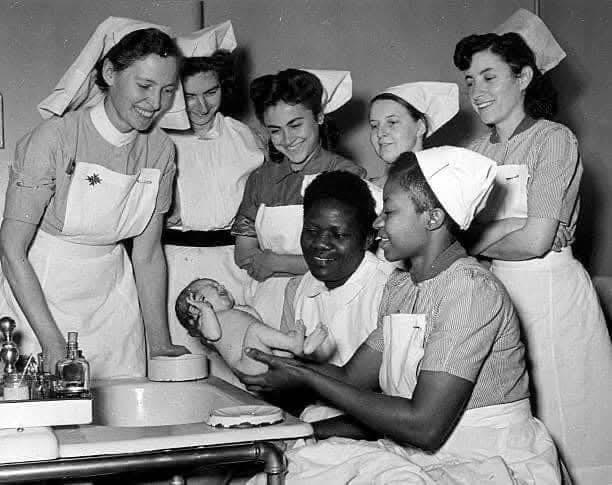
Above is a striking black-and-white photograph taken on 5 February 1948 at the National Training School for Midwives in Woolwich, south-east London, captures two young African women holding a newborn baby.
Surrounded by fellow student nurses, their expressions are calm, assured and professional. At first glance, it is a routine training moment. Historically, it is something far more significant: visual evidence that African women were present at the very foundations of Britain’s National Health Service.
The women in the photograph are Modupe Marke, from Freetown in Sierra Leone, and Rebecca Solanke, from Lagos, Nigeria. Their appearance in a British midwifery training institution months before the NHS officially launched places them among a largely unrecognised group of African migrants whose labour sustained Britain’s post-war healthcare system from its earliest days.
For decades, discussions about migration and the NHS have centred primarily on Caribbean workers, particularly in the context of the Windrush generation. While that history is vital, it has often overshadowed the parallel experiences of continental African women who were already arriving in Britain to study, train and work in health-related professions before and immediately after 1948. It is this imbalance that later inspired projects such as the African Women in the Health Service initiative, developed to recover and document these overlooked lives.
The roots of that project lie in earlier research into Black political activism in Britain. After producing work on the Black Liberation Front, historians involved recognised that African voices were largely absent from narratives of Black British history, including within the NHS. The 70th anniversary of the #NHS in 2018, combined with national reflection following the Windrush scandal, created an opening to examine healthcare history through a broader lens. With support from organisations such as the Ghana Nurses Association, the Nigerian Nurses Charitable Association and the Black Cultural Archives, researchers began systematically uncovering African women’s contributions to British healthcare.
The Woolwich photograph became one such entry point. Shared within community-led digital spaces, including the Nigerian Nostalgia Project, it provided both names and faces—rare anchors in a historical record where African women were often anonymised or omitted altogether.
Rebecca Solanke’s story can be partially reconstructed through surviving records. Born in 1915, she arrived in Southampton from Lagos in 1947 as a qualified midwife. Despite her professional status in Nigeria, British regulations required her to retrain to local standards, which explains her presence at the National Training School for Midwives in 1948.
She completed her nurse training in July 1953 and later returned to Nigeria in 1959, stating her intention to settle permanently. Her journey reflects a common pattern among African women of the era: coming to Britain for training with the expectation of returning home to contribute professionally.
Far less is known about Modupe Marke, underscoring the archival silences that surround many African women’s lives. She appears in the General Nursing Register under the name Florence Eugenia Modupeh Marke (née Coker), having trained at Whittington Hospital and St Leonard’s Hospital in London before entering the register in 1957.
The inconsistencies in naming and the absence of passenger records make it difficult to trace her movements or personal circumstances. Whether she arrived married or single, or how long she remained in Britain, remains unclear.
Yet the absence of detail does not diminish the significance of her presence. Like Solanke, Marke belonged to a generation of African women who filled critical staffing gaps at a time when Britain faced tens of thousands of nursing vacancies. Their labour was not supplementary; it was essential.
The timing of the photograph is particularly striking. It was taken just weeks before the NHS formally came into being on 5 July 1948, and only months before the arrival of the Empire Windrush. This places Marke and Solanke not on the margins of NHS history, but at its inception. They were not latecomers to Britain’s healthcare system; they were already there, already trained, already working.
Despite this, African women often encountered racial discrimination, limited career progression and social isolation. Their professionalism coexisted with structural inequality, and their contributions were rarely acknowledged in official histories. The Woolwich image, preserved in the Daily Mirror archive and later by Mirrorpix and Getty Images, therefore functions as more than a photograph. It is a form of historical testimony.
The careful way the two women hold the newborn challenges narratives that frame colonial migrants as peripheral or unskilled. Instead, it shows African women exercising expertise, responsibility and care at the heart of Britain’s emerging welfare state.
As historians increasingly turn to oral history, community archives and digital platforms to reconstruct these lives, the stories of Modupe Marke and Rebecca Solanke gain renewed importance. They represent not isolated cases, but an entire cohort of African women whose work helped make universal healthcare possible in post-war Britain.
The NHS was never built by Britain alone. From its earliest days, it relied on global labour shaped by empire, migration and resilience. In that quiet room in Woolwich in February 1948, two African women stood at the cradle of a national institution. Their names deserve to be remembered—not as footnotes, but as part of the NHS’s founding story.
 0 Like
1 guest viewing this topic



JapaForum is owned and managed by Semasa Opeoluwa(semasir)
(Read JF Rules)
- Advertise With Us
- Copyright © 2026. All rights reserved.
Disclaimer: Every JapaForum member is solely responsible for anything
that he/she posts or uploads on .
For enquiries & feedbacks send email to: japaforumng@gmail.com